PROJECT: High-Risk Environment Protocol: Laboratory Fire Response & Electrical Safety
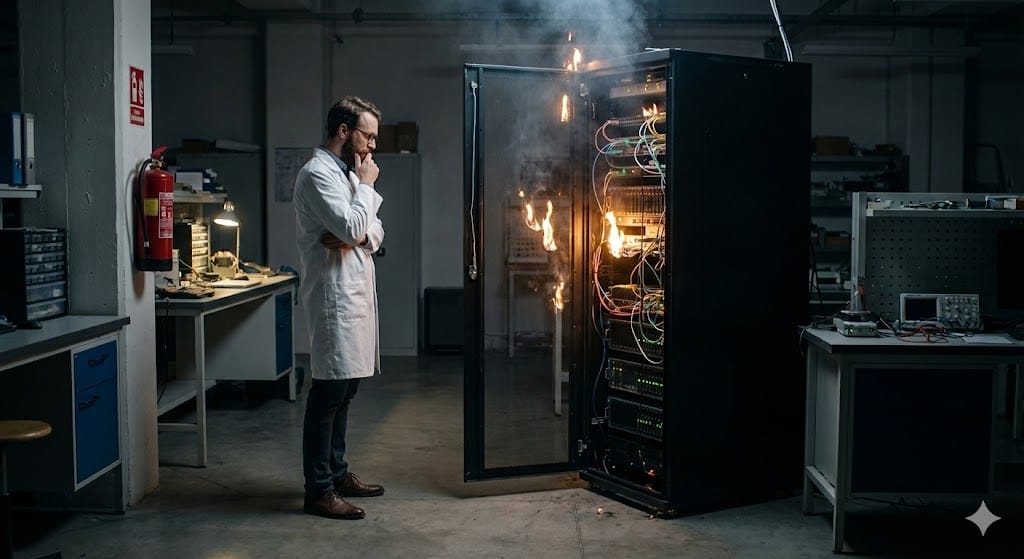
The Challenge: Laboratories house expensive and sensitive equipment, often operating under high voltage. A generic fire response is dangerous; using conductive agents (like foam) on live electronics leads to electrocution, while shutting down critical power systems unnecessarily can ruin experiments or damage assets. Traditional training rarely allows personnel to practice these split-second trade-offs safely.
The Solution: I managed the development of a procedural VR simulator focused on Decision Accuracy. The system forces users to assess the environment and choose the correct protocol based on the state of the equipment:
- Assess the Threat: Is the equipment currently energized (under tension)?
- Execute Protocol: The user must perform the full actuation sequence (e.g., the PASS method for extinguishers or proper draping for fire blankets).
Key Feature 1: Non-Linear Tactical Choice Unlike linear "rail" shooters, this simulation supports branching logic for solving a single problem. For an electrical fire, the user has two valid success paths, testing their situational awareness:
- Path A (Direct Suppression): Recognize the voltage hazard and select the CO2 extinguisher (non-conductive) to suppress the fire immediately while the equipment is live.
- Path B (De-energization): Locate the emergency kill switch, cut the power to the lab bench, and then use the Foam extinguisher (which becomes safe only after de-energization).
- Failure State: Using Foam on live equipment triggers an immediate electrocution event.
Key Feature 2: Tiered Learning Progression ("Crawl-Walk-Run") We implemented a three-stage system to build competence:
- Mode 1: VR Tutorial: A sandbox for VR-naive users to master interactions without stress.
- Mode 2: Guided Practice: Step-by-step scaffolding with holographic overlays teaching the correct sequences.
- Mode 3: Examination: All aids are removed. An Evaluator View on an external screen allows instructors to grade the trainee's decision-making (e.g., "Did they check voltage before spraying?") in real-time.
The Impact:
- Critical Thinking Reinforcement: Moves beyond rote memorization to active problem solving, ensuring personnel understand why they are choosing a specific tool.
- Verified Competence: Provides auditable proof that staff can safely handle fires involving energized equipment.