Project: Aviation Protocol MVP: PED device fire
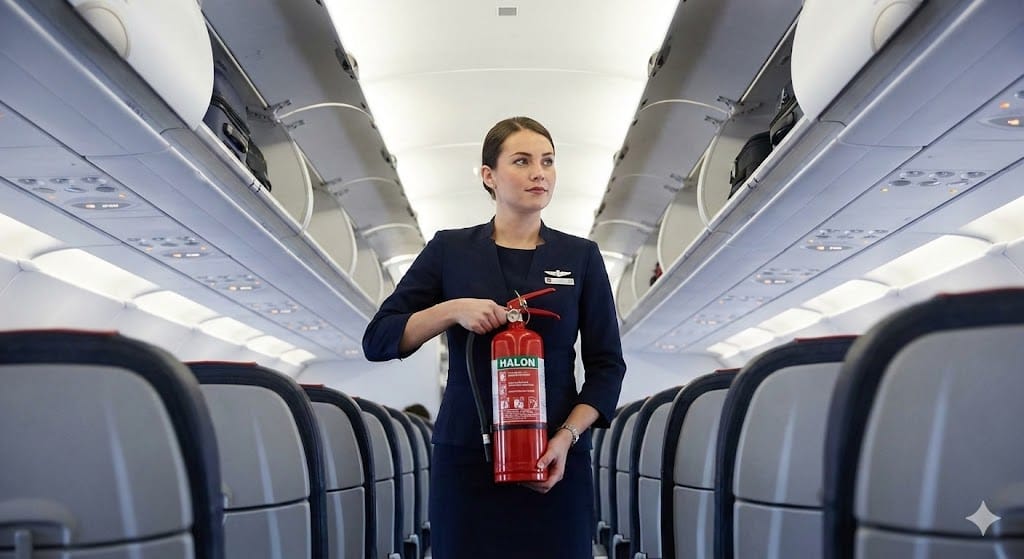
The Challenge: Lithium-ion battery fires (Thermal Runaway) inside an aircraft cabin are among the most critical in-flight emergencies. They are explosive, toxic, and self-sustaining. The Constraint: You cannot safely practice extinguishing a volatile chemical fire inside a real aircraft simulator. Airlines needed a risk-free environment to train crew on the specific, counter-intuitive physics of battery fires.
The Solution: An MVP VR simulator developed in strict collaboration with Aviation Safety Subject Matter Experts (SMEs). The tool focuses on the specific "Checklist Logic" required by international safety standards.
The Procedure (Drill Sequence):
- Thermal Assessment: The user must identify the source of the fire without opening all bins (which would feed the fire with oxygen). This involves detecting heat signatures on the closed locker surfaces.
- Initial Suppression: Applying the Halon extinguisher through a cracked opening.
- Oxygen Starvation: Critical Step. The user must immediately CLOSE the bin after discharge to suffocate the flame. This trains the crew to resist the instinct to "keep looking" at the fire.
- Total Containment: Once stable, the device must be secured using heat-resistant gloves and submerged in a dedicated water container (or cooling bag) to prevent re-ignition.
Key Feature: SME-Validated Physics. The fire behavior in the simulation was tuned by safety experts. If the user fails to "starve" the fire (leaves the bin open too long) or handles the device without cooling, the simulation triggers a re-ignition or explosion event, reinforcing the necessity of the protocol.
The Impact:
- SME-Driven Validation: Proven capability to translate abstract Subject Matter Expertise into executable 3D scenarios. The logic was rigorously validated by safety specialists to ensure strictly accurate procedural modeling.
- Successful Client Adoption: The MVP met all acceptance criteria and was formally adopted by the airline client, proving the viability of VR for high-risk safety training.